April 19, 2026|
For many manufacturers, distributors, and consumer goods companies, customer deductions have become one of the largest sources of hidden revenue leakage. Every day, finance teams spend countless hours researching shortages, pricing claims, compliance chargebacks, returns, freight deductions, and promotional disputes—often using disconnected ERP systems, spreadsheets, email, retailer portals, and paper documentation.
Unfortunately, the process remains largely manual in many organizations. Valuable time is spent gathering supporting documents, validating claims, coordinating internal approvals, and communicating with customers. As deductions age, recovery rates decline, supporting documentation becomes more difficult to obtain, and invalid deductions frequently become permanent write-offs.
Modern deduction automation software fundamentally changes this process.
Today’s leading solutions combine intelligent document processing, workflow automation, retailer portal integration, robotic process automation (RPA), advanced matching algorithms, analytics, and AI-assisted decision support to streamline the entire deduction lifecycle—from initial receipt through validation, dispute management, recovery, reconciliation, and root-cause analysis.
More importantly, organizations are beginning to recognize that deductions are no longer simply an Accounts Receivable function. They represent a strategic opportunity to improve cash flow, protect earned revenue, strengthen customer profitability, and reduce future revenue leakage.
Companies that embrace deduction automation consistently:
- Recover more invalid deductions
- Reduce write-offs
- Accelerate cash flow
- Improve customer relationships
- Increase operational efficiency
- Strengthen EBITDA
- Reduce recurring deductions through continuous process improvement
Ultimately, the objective is not simply to process deductions faster. It is to eliminate the operational issues that create deductions in the first place.
The Growing Cost of Manual Deduction Management
Customer deductions continue to increase in both volume and complexity.
Retail compliance programs, evolving trade promotion strategies, omnichannel fulfillment, electronic proof-of-delivery requirements, supplier portals, and increasingly sophisticated retailer audit programs have created an environment where deductions can occur throughout the entire order-to-cash lifecycle.
Meanwhile, finance organizations face increasing pressure to accomplish more with fewer resources.
Manual deduction processes often require analysts to:
- Review remittance information
- Access multiple retailer portals
- Retrieve proof of delivery
- Research invoices
- Validate pricing
- Review promotional authorizations
- Coordinate with logistics
- Communicate with customer service
- Escalate disputes internally
- Prepare supporting documentation
- Submit disputes through multiple customer portals
- Monitor dispute status
- Reconcile financial transactions
Every manual touchpoint increases processing costs while extending the time required to resolve deductions.
Even more concerning, many organizations devote significant resources to processing valid deductions while insufficient attention is given to recovering invalid claims or identifying recurring operational failures.
The result is predictable:
- Increased deduction aging
- Lower recovery rates
- Higher write-offs
- Reduced working capital
- Poor visibility into customer profitability
- Ongoing revenue leakage
As deduction volumes continue to rise, organizations relying on manual processes often find themselves adding personnel simply to keep pace—a costly strategy that rarely produces meaningful long-term improvements.
Why Deduction Automation Matters
Successful deduction automation is not simply about reducing labor.
It is about improving every aspect of deduction management.
Automation removes repetitive administrative work while allowing experienced deduction professionals to focus on the disputes that have the greatest financial impact.
Modern automation enables organizations to:
- Automatically capture deduction information from multiple sources
- Retrieve supporting documentation without manual intervention
- Validate claims using predefined business rules
- Match deductions against invoices, shipments, pricing, promotions, and proof of delivery
- Route exceptions to appropriate stakeholders
- Prioritize disputes based on value and probability of recovery
- Monitor service-level agreements
- Escalate aging disputes automatically
- Maintain complete audit trails
- Produce real-time management reporting
The result is a faster, more consistent, and more scalable deduction process that reduces administrative effort while improving recovery performance.
Automation Is Only Half the Equation
Technology alone rarely delivers maximum recovery.
While automation dramatically improves efficiency, many of the highest-value deductions still require experienced professionals who understand retailer requirements, promotional agreements, pricing policies, logistics documentation, compliance programs, and dispute negotiation.
Complex deductions involving shortages, post-audit claims, trade promotions, returns, compliance chargebacks, pricing discrepancies, and freight disputes often require judgment that cannot be fully automated.
Organizations that combine intelligent automation with experienced <a href=”https://www.smyyth.com/ar-deduction-services-outsourcing/a-r-deduction-services/”>deduction recovery specialists</a> consistently outperform those relying on software alone.
This hybrid approach enables organizations to:
- Recover more invalid deductions
- Reduce deduction aging
- Improve dispute quality
- Increase recovery rates
- Eliminate repetitive manual activities
- Identify recurring operational failures
- Improve cross-functional collaboration
- Prevent future deductions through root-cause analysis
Rather than viewing automation and expert services as competing alternatives, leading organizations recognize that they complement one another.
Automation accelerates execution.
Experienced professionals maximize recovery.
Together, they create a scalable process capable of improving both short-term cash flow and long-term profitability.
Reporting and Analytics: Turning Deduction Data into Business Intelligence
Many organizations measure the success of deduction management by how quickly disputes are processed. While speed is important, it tells only part of the story.
Modern deduction automation should transform thousands of individual transactions into actionable business intelligence that helps finance, sales, customer service, logistics, supply chain, and executive leadership improve operational performance.
Every deduction tells a story.
A pricing dispute may indicate outdated customer pricing files. A shortage claim could reveal warehouse picking issues or carrier damage. A compliance chargeback may expose recurring labeling deficiencies or shipping process failures. Trade promotion deductions often uncover communication gaps between sales and finance.
Without meaningful reporting, these issues remain hidden, allowing the same deductions to occur repeatedly.
High-performing organizations use deduction analytics to answer questions such as:
- Which customers generate the highest deduction volumes?
- Which deduction categories have the highest recovery potential?
- Which facilities generate the most shortages?
- Which sales promotions create the most disputes?
- Which retailers have the longest dispute cycles?
- Which deductions are aging beyond acceptable limits?
- Where are recurring process failures occurring?
Instead of simply measuring activity, management gains visibility into the operational issues driving revenue leakage.
The result is better decision-making, improved accountability, and stronger financial performance.
The Metrics That Matter
Traditional reporting often focuses only on deduction balances or aging reports.
Modern organizations monitor a much broader set of performance indicators, including:
- Days Deductions Outstanding (DDO)
- Recovery percentage
- Invalid deduction rate
- Average dispute cycle time
- Deduction volume by customer
- Deduction volume by reason code
- Recovery dollars by analyst
- Open deduction aging
- Write-off trends
- Customer profitability
- Root-cause frequency
- Retailer compliance trends
- Working capital impact
These metrics help organizations move beyond tactical dispute management and toward strategic revenue optimization.
Interactive dashboards with drill-down capabilities allow users to analyze deductions by customer, invoice, product, deduction type, distribution center, sales representative, retailer, status, analyst, or business unit.
This level of visibility enables organizations to identify emerging trends before they become costly operational problems.
Workflow Automation: Standardizing Every Step
One of the greatest challenges in deduction management is inconsistency.
Without standardized workflows, every analyst develops their own methods for researching deductions, requesting documentation, communicating with customers, and escalating disputes.
The result is unpredictable outcomes, unnecessary delays, duplicated effort, and inconsistent recovery rates.
Workflow automation replaces these manual, fragmented activities with structured, repeatable processes that improve both efficiency and accountability.
Rather than relying on email chains, spreadsheets, and manual reminders, automation directs every deduction through predefined business rules based on customer requirements, deduction type, dollar value, aging, and recovery probability.
Routine activities are completed automatically, allowing analysts to focus on complex exceptions requiring human judgment.
Modern workflow automation should include:
- Automated deduction intake from ERP systems, remittance files, EDI transactions, and retailer portals
- Intelligent document retrieval
- Proof of delivery acquisition
- Invoice and shipment validation
- Automated transaction matching
- Pricing verification
- Promotion validation
- Retailer portal integration
- Carrier portal integration
- Intelligent work queues
- Automated routing
- Service Level Agreement (SLA) monitoring
- Escalation management
- Approval workflows
- Customer communications
- ERP integration
- Robotic Process Automation (RPA)
As deductions move through the process, every activity is automatically tracked, creating complete audit trails while providing management with real-time visibility into productivity and bottlenecks.
The result is a faster, more consistent dispute resolution process with significantly less manual effort.
Eliminating Process Waste
Lean manufacturing introduced the concept of eliminating waste from production processes.
The same principle applies to deduction management.
Every unnecessary manual activity increases processing costs while delaying recovery.
Common sources of waste include:
- Searching multiple systems for documentation
- Manually downloading retailer reports
- Re-entering data
- Repeated customer follow-up emails
- Duplicate research
- Manual status updates
- Delayed approvals
- Lost documentation
- Inconsistent escalation procedures
Automation removes much of this waste by connecting systems, automating repetitive tasks, and presenting analysts with complete deduction files rather than requiring them to assemble information manually.
The result is increased productivity without increasing headcount.
Governance: Creating Financial Discipline
Deduction management does not end when a dispute is resolved.
Strong governance ensures that every deduction is accurately reflected throughout the financial reporting process while supporting audit readiness and regulatory compliance.
Automation improves governance by ensuring deductions are:
- Properly classified
- Timely expensed
- Matched against customer payments
- Reconciled to the general ledger
- Applied to the appropriate accounting periods
- Supported by complete documentation
- Available for future audit and research
Automated reconciliation processes help identify debit-credit offsets, duplicate deductions, unapplied credits, and outstanding variances before they become larger financial issues.
Finance teams also gain greater confidence in:
- Accounts receivable reserve calculations
- Write-off approvals
- Recovery tracking
- Customer profitability reporting
- Revenue recognition support
- Financial forecasting
Instead of relying on manual spreadsheets during month-end close, organizations benefit from timely, transparent financial reporting supported by complete transaction histories.
This strengthens both operational control and executive confidence.
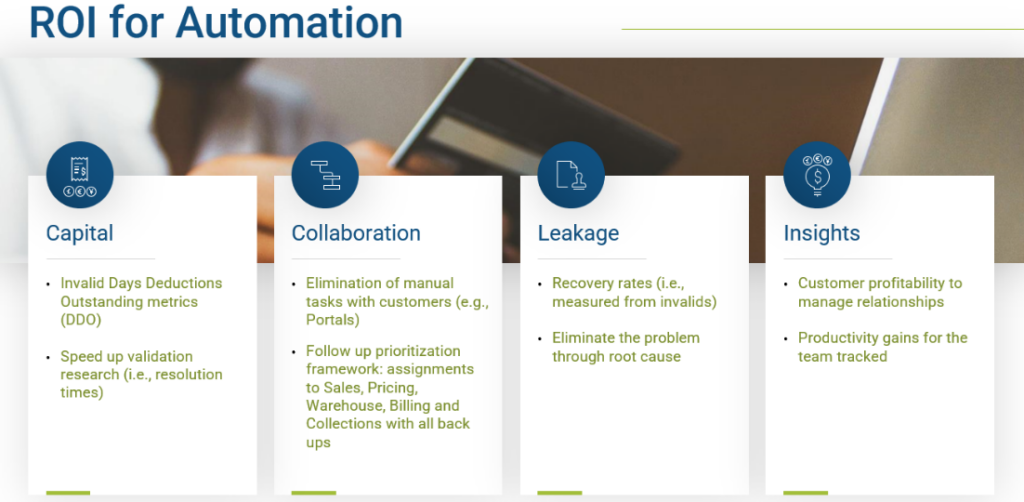
Measuring the Return on Investment
One of the greatest advantages of deduction automation is that success can be measured objectively.
Unlike many technology initiatives, deduction automation produces tangible financial improvements that are visible across both finance and operations.
Organizations typically evaluate success using metrics such as:
- Lower Days Deductions Outstanding (DDO)
- Higher recovery percentages
- Faster dispute resolution
- Reduced write-offs
- Lower administrative costs
- Reduced manual touches
- Improved analyst productivity
- Increased cash flow
- Better working capital performance
- Improved customer profitability
- Reduced recurring deduction categories
Perhaps the most valuable benefit is one that is often overlooked.
As organizations identify and eliminate the operational issues responsible for recurring deductions, the total number of future disputes begins to decline.
That creates lasting profitability improvements that extend far beyond the recovery of individual deductions.
In other words, the greatest return on investment is often not recovering today’s deductions—it’s preventing tomorrow’s.
AI Is Changing Deduction Management
Artificial intelligence is rapidly reshaping the way organizations manage deductions—but not in the way many headlines suggest.
The greatest value of AI today is not replacing deduction analysts. It is helping experienced professionals make faster, more informed decisions by reducing manual effort, identifying patterns, and prioritizing work based on financial impact.
Modern deduction management platforms increasingly use AI-assisted capabilities to:
- Classify deduction types
- Recommend next-best actions
- Prioritize disputes based on recovery probability
- Identify recurring operational patterns
- Detect anomalies
- Suggest supporting documentation
- Improve matching accuracy
- Forecast workload and recovery performance
These capabilities allow analysts to focus on complex disputes requiring negotiation and business judgment while routine activities are completed through automation.
The result is improved productivity without sacrificing quality.
As AI capabilities continue to mature, organizations will increasingly shift from reacting to deductions toward predicting and preventing them.
Prevent Deductions Before They Occur
Recovering invalid deductions is important.
Preventing them altogether is even more valuable.
Every recurring deduction represents an operational issue that should be investigated and resolved.
Root-cause analysis transforms deduction management from a reactive accounts receivable function into a proactive business improvement initiative.
Modern deduction analytics help organizations identify recurring issues involving:
- Shipment shortages
- Pricing discrepancies
- Unauthorized deductions
- Trade promotion execution
- Returns processing
- Vendor compliance violations
- EDI failures
- Customer master data errors
- Freight discrepancies
- Warehouse execution
- Order fulfillment
- Proof of delivery
By identifying these trends early, organizations can implement corrective actions that permanently reduce future deductions.
Rather than repeatedly recovering the same types of deductions, they eliminate the underlying operational failures responsible for creating them.
This shift from recovery to prevention represents one of the greatest long-term profitability opportunities available to finance organizations.
Retailer Portal Automation
Supplier portals have become one of the most significant challenges in modern deduction management.
Major retailers increasingly communicate deductions, shortages, compliance violations, returns, and supporting documentation through individual supplier portals.
Finance teams often spend hours each day manually logging into multiple retailer systems, downloading reports, retrieving documents, checking claim status, and submitting disputes.
This manual effort creates unnecessary delays while increasing administrative costs.
Retailer portal automation fundamentally changes this process.
Solutions such as Carixa® PortalExchange automate many of these repetitive activities by securely connecting to retailer portals and continuously exchanging information between customer systems and internal workflows.
Portal automation can:
- Monitor retailer portals automatically
- Retrieve deduction documentation
- Download supporting files
- Capture proof of delivery
- Import shortage details
- Submit disputes electronically
- Track claim status
- Notify stakeholders of updates
- Trigger automated workflows
- Reduce manual portal activity
Rather than requiring analysts to repeatedly visit multiple customer websites, information is delivered directly into the deduction management workflow where it can be reviewed, validated, and acted upon immediately.
The result is faster dispute resolution, reduced labor requirements, improved compliance with customer response deadlines, and significantly higher recovery rates.
Getting Started with Deduction Automation
Implementing deduction automation requires more than installing software.
Successful projects begin with a clear understanding of existing deduction processes, organizational responsibilities, system integrations, and desired business outcomes.
Organizations should first establish measurable objectives, such as:
- Reducing Days Deductions Outstanding (DDO)
- Increasing recovery rates
- Reducing write-offs
- Improving analyst productivity
- Accelerating cash flow
- Improving working capital
- Reducing recurring deduction categories
- Increasing customer profitability
Equally important is building a cross-functional project team.
Deduction management affects nearly every customer-facing function within an organization, including:
- Finance
- Accounts Receivable
- Sales
- Customer Service
- Supply Chain
- Logistics
- Trade Promotion
- IT
- Accounting
- Treasury
Successful implementations combine executive sponsorship with detailed operational knowledge.
Organizations should document approval workflows, establish ownership for each deduction category, define escalation procedures, identify integration requirements, and create reporting standards that support continuous improvement.
Most importantly, deduction automation should not be viewed as a one-time technology project.
It should become an ongoing business process focused on continuously reducing revenue leakage while improving operational performance.
The Smyyth Advantage
Technology alone does not recover deductions. People alone cannot efficiently manage today’s deduction volumes. Smyyth combines both.
By integrating Carixa® Deduct, Carixa® PortalExchange for intelligent automation, AI-assisted workflows, and experienced deduction recovery professionals, organizations gain a complete solution for managing the entire deduction lifecycle, starting with the chain retail vendor portals.
This hybrid approach helps organizations:
- Recover more invalid deductions
- Reduce administrative effort
- Accelerate dispute resolution
- Improve retailer collaboration
- Increase analyst productivity
- Strengthen financial controls
- Improve working capital
- Reduce recurring deductions
- Protect long-term profitability
Whether organizations require software, managed services, or a fully outsourced recovery program, Smyyth delivers the technology, expertise, and operational experience necessary to maximize financial results.
Conclusion: From Deduction Management to Revenue Optimization
Deduction automation has evolved far beyond workflow management.
Today, it serves as a strategic capability that helps organizations recover earned revenue, improve working capital, strengthen customer relationships, and eliminate recurring operational inefficiencies.
The most successful organizations no longer measure success simply by the number of deductions processed. They measure improvements in profitability.
By combining intelligent automation, AI-assisted decision support, retailer portal connectivity, advanced analytics, and experienced recovery professionals, companies can transform deduction management from an administrative burden into a competitive advantage.
As deduction volumes continue to increase, organizations that modernize their processes will be better positioned to accelerate cash flow, reduce write-offs, improve customer profitability, and protect long-term revenue.
The greatest opportunity is not simply recovering today’s deductions. It is preventing tomorrow’s.
Ready to Recover More Revenue?
Whether you’re evaluating deduction services or software, looking to improve retailer portal management, or seeking experienced specialists to accelerate deduction recovery, Smyyth can help.
Our team combines advanced automation with decades of operational expertise to help organizations reduce revenue leakage, improve cash flow, and build sustainable deduction management processes.
Schedule a complimentary Deduction Recovery Services Assessment to identify automation opportunities, uncover hidden recovery potential, and develop a roadmap for improving profitability.
Ready to turn your deductions into recovered profit? Schedule a consultation with our team today.
Frequently Asked Questions
What is deduction automation?
Deduction automation uses software to capture, validate, route, document, reconcile, and resolve customer deductions while reducing manual effort and improving recovery performance.
How does deduction automation improve profitability?
Automation accelerates deduction resolution, reduces write-offs, improves recovery rates, increases analyst productivity, and identifies recurring operational issues that contribute to revenue leakage.
What types of deductions can be automated?
Modern deduction automation supports shortages, pricing claims, compliance chargebacks, freight deductions, trade promotions, returns, rebates, post-audit claims, and many other deduction categories.
Can AI replace deduction analysts?
No. AI enhances experienced professionals by helping prioritize work, classify deductions, identify trends, recommend next-best actions, and improve matching accuracy. Human expertise remains essential for complex disputes and customer negotiations.
Can deduction automation integrate with ERP systems?
Yes. Modern platforms integrate with ERP systems, cash application solutions, retailer portals, transportation systems, document repositories, EDI platforms, and customer service applications to streamline deduction management.
What is retailer portal automation?
Retailer portal automation securely connects supplier workflows with retailer portals to automatically retrieve deduction information, supporting documentation, proof of delivery, claim updates, and other critical data while reducing manual effort.
How do I measure ROI from deduction automation?
Key performance indicators include lower Days Deductions Outstanding (DDO), higher recovery rates, reduced write-offs, improved analyst productivity, lower processing costs, improved working capital, and fewer recurring deduction categories.
Should deduction automation be combined with managed recovery services?
Many organizations achieve the greatest results by combining automation with experienced deduction recovery professionals. Automation improves efficiency, while experienced specialists maximize recovery, resolve complex disputes, and identify opportunities to prevent future deductions.
Ready to turn your data into dollars? Schedule a consultation with our team today.